




Anthropic launched Claude Opus 5 on July 24, 2026, marking a significant shift in the economics of frontier AI. The new model delivers near-Fable 5 performance at half the input cost, with a novel effort toggle that lets teams trade capability for cost on a per-request basis. For the first time, the Opus tier is positioned not as a budget option, but as the practical frontier for production work.
What Is Claude Opus 5?
Claude Opus 5 is Anthropic's new general-purpose near-frontier model. It ships with a 1M-token context window, extended thinking enabled by default, and a new low/medium/high effort control that adjusts reasoning depth per request. The headline specs are straightforward: $5 per million input tokens and $25 per million output tokens — the same rate as Opus 4.8, but with a full generation of capability gains.
The model is available on Claude.ai (as the default on Claude Max), Claude Code, Claude Cowork, and the Claude API as claude-opus-5. Anthropic also rolled out a new safety feature called Automatic Fallbacks, which routes requests that trigger safety classifiers to a less-powerful model instead of returning an error — keeping production pipelines from hard-failing on false positives.

The Benchmarks: Where Opus 5 Wins
Opus 5's launch numbers show a clear pattern: it leads on the benchmarks that matter most for real work — coding, reasoning, and agentic tasks.
On Frontier-Bench v0.1, Anthropic's agentic-coding evaluation, Opus 5 scores 43.3% — more than double Opus 4.8 and beating both Fable 5 (33.7%) and OpenAI's GPT-5.6 Sol (34.4%). This is the single largest capability jump between Opus 4.8 and Opus 5, and it's the benchmark where the cheaper model outperforms the frontier.
On ARC-AGI-3, a test of novel problem-solving that stresses genuine reasoning, Opus 5 scores 30.2% — roughly three times better than GPT-5.6 Sol's 7.8%. This is a blowout.
On GDPval-AA v2, a human-graded Elo rating of real economic knowledge-work tasks, Opus 5 sits at 1,861 — above both Fable 5 (1,747) and GPT-5.6 Sol (1,736).
On SWE-bench Pro, the one place Opus 5 doesn't lead, it still posts 79.2% — trailing Mythos 5 (80.3%) and Fable 5 (80.0%) by less than a point, but far ahead of Opus 4.8's 69.2%.
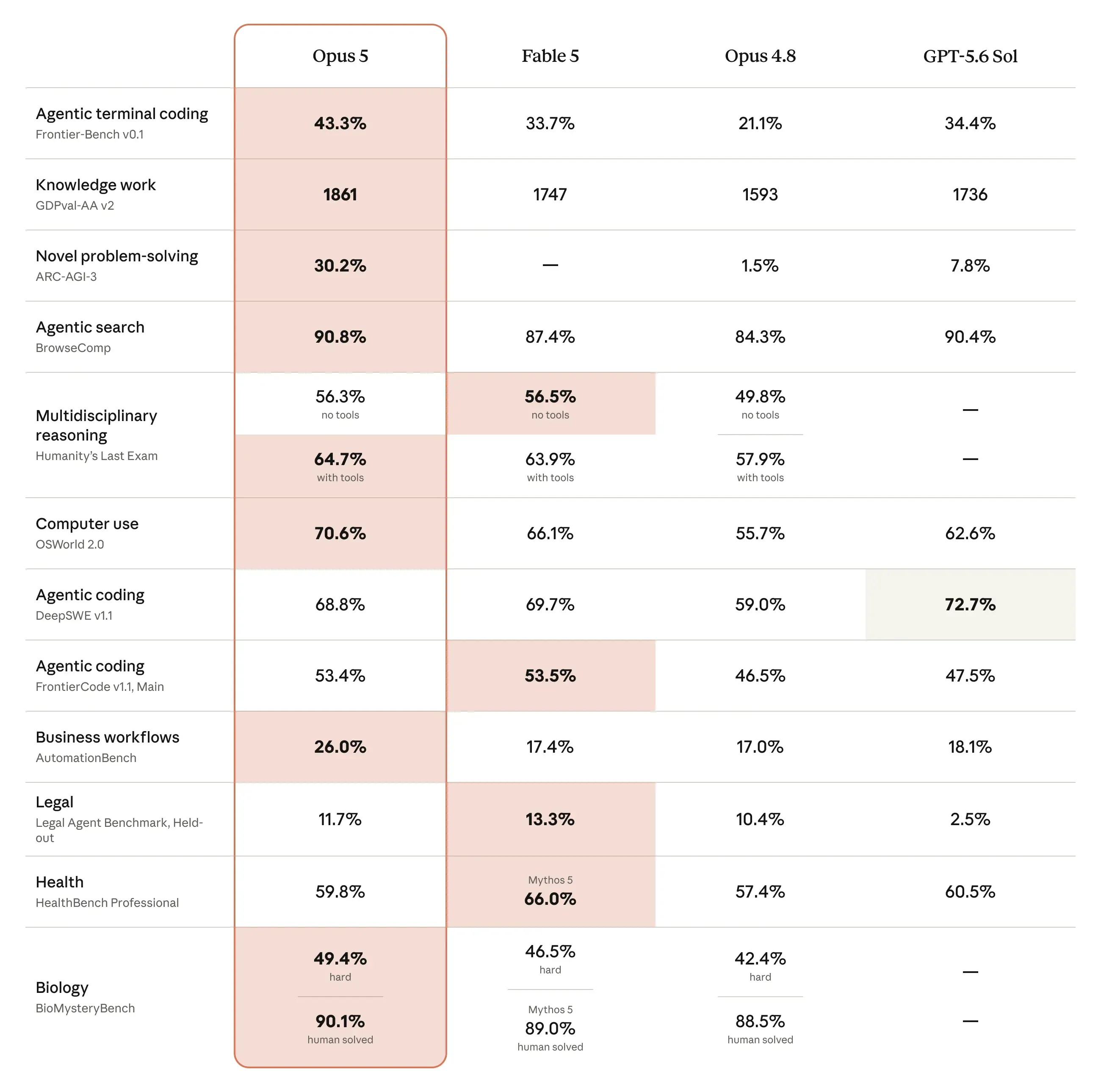
Beyond raw scores, Anthropic highlighted framed results: on CursorBench at max effort, Opus 5 lands within 0.5 points of Fable 5 at roughly half the cost per task. On Zapier's AutomationBench, it completed a full end-to-end churn-prevention workflow at 1.5× the performance of the next-closest model at matching cost. On OSWorld 2.0 (computer-use tasks), it outperforms rivals at every price point, beating Fable 5's peak using about one-third the budget.
The Effort Toggle: Cost Meets Capability
The effort toggle is the feature that separates Opus 5 from a simple price cut. Because extended thinking is on by default, the tokens spent reasoning are billed as output. The effort dial controls that reasoning budget:
- Low effort caps reasoning tokens and returns faster and cheaper — ideal for routine tasks like lint fixes, short summaries, or well-scoped functions.
- Medium effort balances cost and capability for standard work.
- High effort lets the model reason as long as it needs for genuinely hard problems.
In practice, a team that routes 80% of traffic through low/medium and reserves high for the hardest 20% will pay far less than the per-token rate suggests. This is Anthropic's lever for making frontier reasoning accessible without runaway inference bills.
What's New vs. Opus 4.8
Opus 5 shipped just two months after Opus 4.8 (May 28, 2026), and the changes are substantial:
Self-correction and verification. Opus 5 "excels at verifying its work and iterating carefully until it succeeds." Anthropic highlighted an example where the model wrote its own computer-vision pipeline from an incomplete prompt — filling gaps, testing, and fixing its own mistakes without human intervention. In agent loops, this means fewer rounds of "no, that's wrong, try again."
Agentic coding jump. On Frontier-Bench, Opus 5 more than doubles Opus 4.8's pass rate while costing less per task. This is the single largest capability delta.
Science and safety. Opus 5 improves on Opus 4.8 across every life-sciences evaluation, with 10-plus-point gains in organic chemistry and related fields. On safety, it has stronger cybersecurity guardrails — it can examine source code but won't scan compiled binaries for vulnerabilities. Anthropic's automated behavioral audit scores it as the most-aligned model to date, and it's not subject to the 30-day data-retention policy that covers Fable 5.
Opus 5 vs. Fable 5: When to Use Each
For the overwhelming majority of coding, agentic, and knowledge work, Opus 5 is the right choice. It matches or beats Fable 5 on most public benchmarks, costs half as much on input, and carries fewer data-retention and refusal frictions.
Fable 5 is still the call for genuinely frontier work: long-horizon agents that run autonomously for days, or the hardest research problems where cost is secondary and you want the absolute top of Anthropic's lineup. Anthropic itself still recommends Fable 5 for those cases.
Mythos 5 remains the specialist for frontier cybersecurity exploitation and the most demanding biology research.
Pricing and Availability
Opus 5 pricing is:
- Standard mode: $5 per million input tokens, $25 per million output tokens
- Fast mode: $10 per million input tokens, $50 per million output tokens (2.5× faster latency)
This is the same headline rate as Opus 4.8 and half of Fable 5's input price. With prompt caching, you can save up to 90% on input tokens; with batch processing, 50% on output tokens.
Opus 5 is available on:
- Claude.ai (default on Claude Max, strongest on Claude Pro)
- Claude Code (with fast mode)
- Claude Cowork
- Claude API and Platform (
claude-opus-5) - Amazon Bedrock, Google Cloud Vertex AI, and Microsoft Foundry
The Bottom Line
Claude Opus 5 represents a meaningful shift in AI economics. For the first time, a model in the Opus tier is positioned not as a budget option, but as the practical frontier for production work. It beats its flagship sibling on multiple benchmarks, costs half as much on input, and adds a control — the effort toggle — that lets teams optimize for their actual workload.
If you're on Opus 4.8, the upgrade is straightforward: same price, generational jump, drop-in model ID change. If you're on Fable 5 for everything, routing routine traffic to Opus 5 and keeping Fable 5 for the genuinely hard 10–20% will cut costs sharply with little quality loss. If you're on a competitor, Opus 5's agentic-coding and reasoning lead, plus the effort toggle and no 30-day retention, make it worth a serious evaluation — especially for developer-tool and agent workloads.
This is the model most teams will actually run every day.
Comments
Leave a comment
Related articles

Claude Fable 5.1: Same $10/$50 Price, 75% Cheaper Cache Reads, and Benchmarks That Double the Gap
Claude Fable 5.1 is live — same $10/$50 rate card as Fable 5, but cache reads drop 75% to $0.25/1M, cutting typical workload cost ~25% and agentic cost up to ~45%. Full benchmark table vs. Fable 5, Opus 5, and GPT-5.6 Sol.

Claude Max Weekly Limits: The 50% Summer Boost Becomes a Permanent 25% Raise — Math Included
Anthropic's temporary 50% Claude Code weekly boost ends September 13. On September 14 a permanent 25% increase to baseline limits takes over — a net ~17% cut for active users. The math, the timeline, what stays doubled.

Ox Alpha: The Anonymous 1M-Context Coding Model That Has Everyone Guessing Z.ai
Ox Alpha is a free, anonymous 1M-context reasoning model on OpenRouter. Community fingerprinting points to Zhipu AI's GLM-5.x. We break down the benchmarks, the mystery, and the adoption.