



OpenAI launched GPT-Live on July 8, 2026, and it's the first voice model that doesn't make you feel like you're talking to a walkie-talkie. More than 150 million people use ChatGPT Voice weekly, and every single one of them was stuck with a half-duplex system that waited for silence before responding. GPT-Live replaces that turn-based architecture with full-duplex — the model listens and speaks at the same time, makes decisions about whether to interrupt, acknowledge, or stay quiet many times per second, and delegates hard questions to GPT-5.5 in the background while keeping the conversation flowing. It's not an incremental improvement to Advanced Voice Mode. It's a complete architectural replacement, and it changes what voice AI can actually do in production.
What Full-Duplex Actually Means
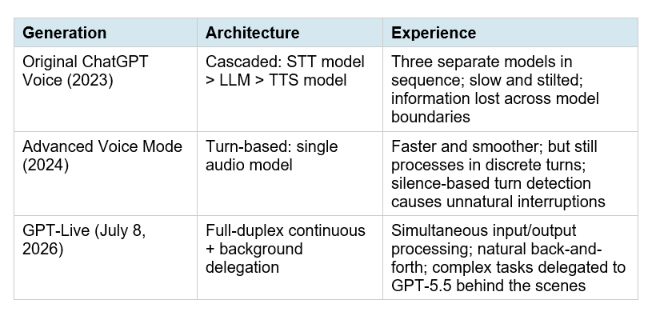
Full-duplex is a telecom term: both sides transmit simultaneously, like a phone call. Half-duplex is a walkie-talkie — one speaks, then the other. ChatGPT's Advanced Voice Mode was half-duplex despite being an end-to-end audio model. It used silence detection to decide when your turn ended, which caused two specific problems: interrupting you when you paused to think, and misreading background noise as the end of your turn.
GPT-Live eliminates both by processing input and output continuously. The model makes interaction decisions at sub-second intervals: speak, listen, pause, acknowledge, interrupt, or invoke a tool. The practical effects are immediate.
Active Listening Acknowledgment
GPT-Live says "mhmm," "yeah," "got it" while you're talking. It can do this because it's processing your audio in real time, not waiting for you to finish. It sounds obvious, but no prior voice model pulled this off naturally because the architecture wasn't designed for concurrent streams.
Thinking Pauses Respected
If you stop mid-sentence to think, GPT-Live waits. It distinguishes a thinking pause from the end of a turn because it's continuously processing the audio stream, not waiting for a silence threshold to trip. This alone fixes the most annoying behavior of every voice assistant on the market.
Interruption Handling
You can cut GPT-Live off mid-sentence with a question or correction. The model processes the interruption in real time and responds without losing context. Again, this sounds obvious. No major voice assistant did it well before.
Live Translation
Full-duplex enables real-time translation as a natural capability — the model processes incoming audio in one language while generating output in another simultaneously. OpenAI demoed this during the launch briefing, though the Hindi demo showed a heavy American accent and bookish tone. The feature is optimized for "most spoken languages," but OpenAI hasn't published the full list.
The Delegation Layer: Voice Model + GPT-5.5
Full-duplex fixes the conversation flow. The delegation layer fixes the intelligence ceiling.
In Advanced Voice Mode, the voice model was the intelligence. If you asked something that required web search, the conversation stopped while the model searched, processed, and responded. The quality ceiling for complex questions was the voice model's own capability. GPT-Live decouples the conversational interface from the intelligence by routing complex tasks to GPT-5.5 running in the background.
You ask a hard factual question. GPT-Live says "Let me look that up" and keeps talking about something related while GPT-5.5 retrieves the answer. Then GPT-Live incorporates the result naturally when it's ready. The conversation never stops. The intelligence ceiling is GPT-5.5, not the voice model.
The strategic play here is obvious: GPT-Live isn't tied to any specific backend model. As OpenAI releases GPT-5.6 Sol, Terra, Luna, and whatever comes next, the intelligence ceiling rises automatically without requiring a new voice model architecture. At launch it uses GPT-5.5. Future upgrades will use whatever OpenAI's current frontier model is.
GPT-Live-1 and GPT-Live-1 Mini: What You Get By Tier
OpenAI launched two variants:
GPT-Live-1 is the full model. It's the default on paid ChatGPT plans (Plus, Pro, Team, Enterprise). It gets access to all four reasoning tiers and the full delegation pipeline to GPT-5.5.
GPT-Live-1 Mini powers the free tier. It gets the full-duplex architecture, active listening, visual cards, background noise handling — the core natural conversation upgrade. What it doesn't get is the deeper reasoning tiers. Free users get the same conversational experience but with less capable background intelligence for complex questions.
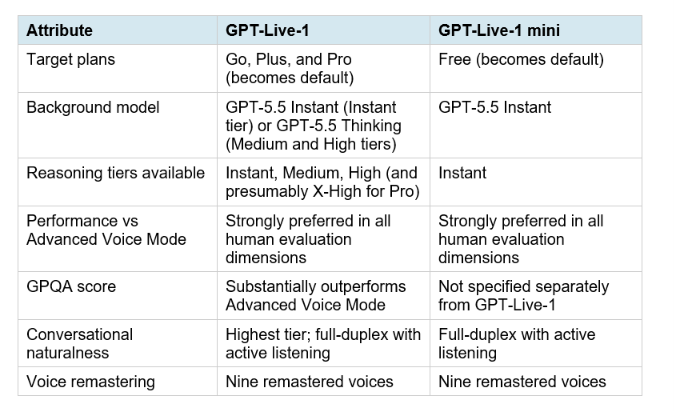
This is a sensible cut. The conversational quality — which is what people actually notice moment to moment — isn't gated. The deeper thinking for hard problems is. And the mini variant still replaces the old Advanced Voice Mode entirely, which was the default on free tier before.
The Four Reasoning Tiers
GPT-Live introduces four reasoning tiers that control which background model handles delegation and at what effort level. This is the most practically important configuration detail for anyone using GPT-Live seriously.
- Instant: Fast responses, minimal background reasoning. Best for quick Q&A, casual conversation, routine commands.
- Low: Some reasoning depth, faster turnaround. Fine for most daily use.
- Medium: Balanced reasoning. GPT-5.5 Thinking handles the delegation work. Good for complex explanations, planning, analysis.
- High: Max reasoning depth. GPT-5.5 Thinking runs at full effort. Use for hard problems where you want the ceiling.
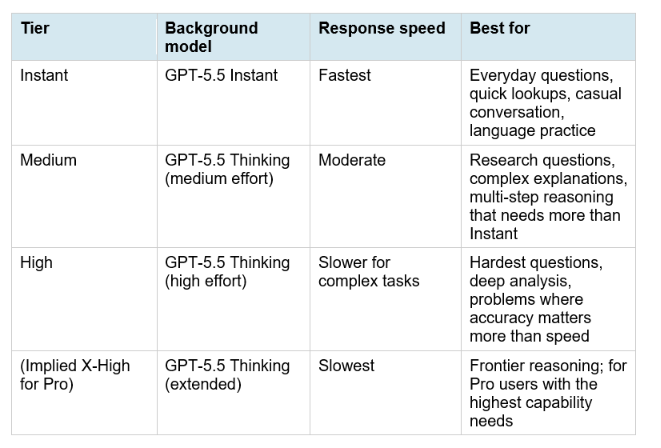
The tier selection happens in the ChatGPT interface before or during a voice conversation. Because the delegation is asynchronous, choosing Medium or High doesn't slow down the conversational flow — GPT-Live keeps talking while GPT-5.5 works in the background. You only notice the latency when the answer comes back.
Benchmarks vs. Advanced Voice Mode
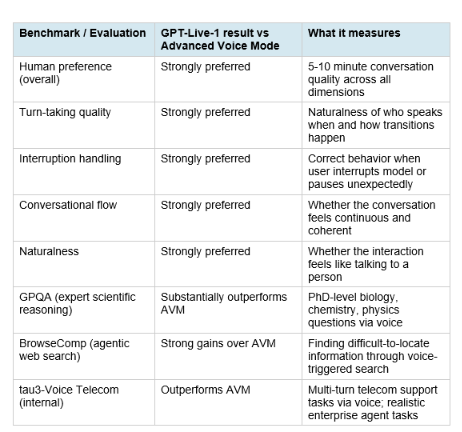
OpenAI built new human evaluation frameworks specifically for GPT-Live because existing voice benchmarks didn't measure what matters in a full-duplex system. They ran matched 5-10 minute conversations across five dimensions.
On overall preference, GPT-Live-1 scored 75.5 vs. Advanced Voice Mode's baseline — a decisive win. On turn-taking quality, interruption handling, and conversational flow, GPT-Live-1 was strongly preferred across every human evaluation. On GPQA (graduate-level Q&A), GPT-Live-1's delegation to GPT-5.5 crushed the old model's standalone capability.
The enterprise-relevant data point is tau3-Voice Telecom, a multi-turn customer support benchmark. GPT-Live-1 outperforms Advanced Voice Mode on realistic support scenarios — the exact use case most teams building voice agents care about.
Visual Cards: Seeing While Speaking
GPT-Live introduces visual cards that surface alongside the voice conversation. For weather, stocks, sports, and maps, the model automatically displays a visual card while it's talking. You ask about the weather in Denver, you hear the forecast and see a card. You ask about stock prices, you hear the numbers and see a chart. You ask for nearby restaurants, you hear recommendations and see a map.
This is strategically bigger than it sounds. Voice AI has historically been limited to audio-native use cases. Visual cards make GPT-Live a combined audio-visual interface where the voice handles the conversation and the cards handle structured data. It's closer to how humans actually communicate — we pull out our phones to show someone a map while we're talking. This is the first mainstream AI product that genuinely replicates that pattern.
Safety: Voice-Native Protections
Voice introduces safety risks that don't exist in text, and OpenAI built voice-native safeguards for GPT-Live. The testing covered self-harm, psychosis and mania, emotional reliance on AI, violence, and sexual content — but tested with audio-native evaluations, not text equivalents.
Real-time safeguards can intervene while the model is speaking, not just after a response is complete. OpenAI's architecture can detect potentially unsafe output mid-stream and steer the model toward a safer response, surface crisis resources, or end the conversation entirely in high-risk cases.
Teen-specific protections are the most notable policy addition. Three layers: age-appropriate behavior trained directly into the model, parental controls to block ChatGPT Voice access for teens, and linked parent notification in higher-risk situations involving self-harm or suicidal intent. This creates a direct escalation path from GPT-Live's detection to a trusted adult — a more aggressive safety posture than any prior ChatGPT voice release.
Voice impersonation prevention is straightforward: GPT-Live uses nine predefined voices with safeguards against imitating any specific real person's voice.
Availability and Rollout
GPT-Live-1 and GPT-Live-1 Mini are rolling out now to ChatGPT on iOS, Android, and web. Paid tiers get GPT-Live-1 by default; free tier gets GPT-Live-1 Mini. OpenAI remastered all nine existing ChatGPT voices for the new architecture.
The API is not available yet. OpenAI says API access is planned soon; developers can sign up for notification on OpenAI's form. For API voice today, the option remains GPT-Realtime-2 on the Realtime API. This is a ChatGPT-only launch.
What This Means for Voice AI
GPT-Live is the first voice model that treats conversation as a continuous stream rather than a sequence of turns. That sounds like a technical detail, but it's the difference between talking to a person and talking to a machine that needs you to finish before it starts. Combined with background delegation to GPT-5.5 and visual cards, it's the most complete voice AI interface on the market right now.
The limitations are real — the live translation still sounds unnatural outside English, the API isn't available for developers building their own voice agents, and full-duplex introduces latency and compute costs that OpenAI hasn't detailed. But the architecture is the direction the entire industry is heading. Every voice assistant that doesn't move to full-duplex in the next twelve months will feel obsolete.
OpenAI's product lead Atty Eleti said during the briefing that he's had 30- to 40-minute voice conversations with GPT-Live on walks. I don't know anyone who did that with Advanced Voice Mode.
Comments
Leave a comment
Related articles

Claude Fable 5.1: Same $10/$50 Price, 75% Cheaper Cache Reads, and Benchmarks That Double the Gap
Claude Fable 5.1 is live — same $10/$50 rate card as Fable 5, but cache reads drop 75% to $0.25/1M, cutting typical workload cost ~25% and agentic cost up to ~45%. Full benchmark table vs. Fable 5, Opus 5, and GPT-5.6 Sol.

Claude Max Weekly Limits: The 50% Summer Boost Becomes a Permanent 25% Raise — Math Included
Anthropic's temporary 50% Claude Code weekly boost ends September 13. On September 14 a permanent 25% increase to baseline limits takes over — a net ~17% cut for active users. The math, the timeline, what stays doubled.

Ox Alpha: The Anonymous 1M-Context Coding Model That Has Everyone Guessing Z.ai
Ox Alpha is a free, anonymous 1M-context reasoning model on OpenRouter. Community fingerprinting points to Zhipu AI's GLM-5.x. We break down the benchmarks, the mystery, and the adoption.